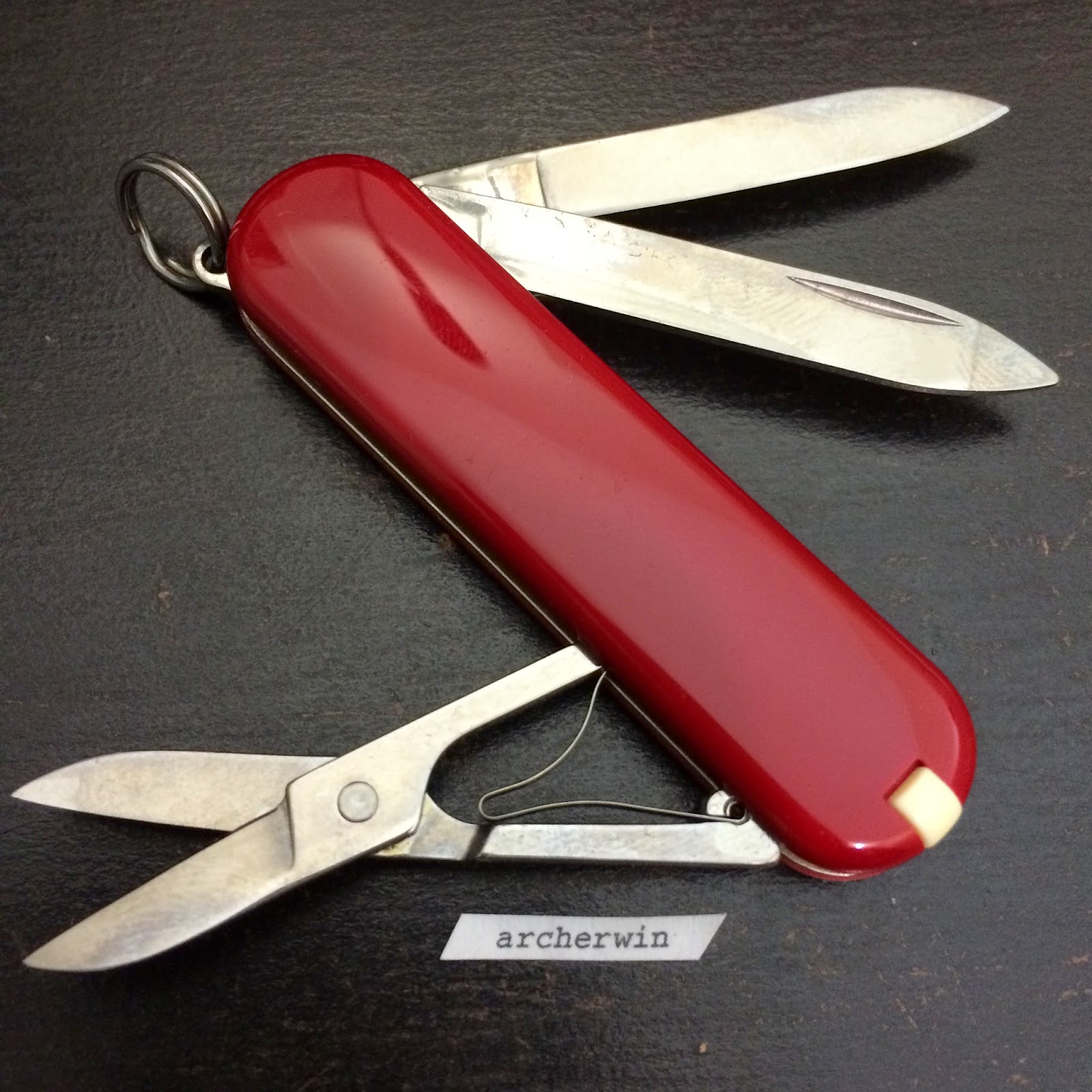
Here's my Victorinox Champion Plus. It's a seven-layer 91mm SAK which is one layer less than the SwissChamp. This has all the SwissChamp's tools except the pliers. It is one layer thicker than the original Champion and has additional magnifying glass and inline philips screwdriver on the extra layer.
L.L.Bean, Inc., branded as L.L.Bean, is an American privately held mail-order, online, and retail company founded in 1912 by Leon Leonwood Bean and currently based in Freeport, Maine, United States.
The national flag of Romania is a tricolour with an aspect ratio of 2:3 (width-to-length) and has equal vertical stripes of blue, yellow and red.
The colors represent the principalities of the two largest regions (Wallachia and Moldavia) in Romania which united along with Transylvania to form the Kingdom of Romania in 1881. Red and yellow represent the principalities of Wallachia; and red and blue represent the principalities of Moldavia. In 1821, for the first time a meaning was attributed to them: Liberty (sky blue), Justice (field yellow) and Fraternity (red)
The tricolour was first adopted in Wallachia in 1834 but the order of the colors were changed. In June 1848, the revolutionaries that year adopted a flag with horizontal stripes of blue, yellow and red for Wallachia. The following month, July 1848, a decree was passed changing the horizontal stripes to vertical stripes with the same order of colors. Then in 1866, under Article 124 of the 1866 Constitution of Romania provided the current design of the national flag with the order and placement of the colors later decided by the Assembly of Deputies in 1867.
Some odd facts about this tricoloured flag. The Romanian flag is very similar to the flags of two countries - Andorra (which is a sovereign landlocked microstate in Southwestern Europe, located in the eastern Pyrenees mountains and bordered by Spain and France) and Chad (which is a landlocked country in Central Africa. It is bordered by Libya to the north, Sudan to the east, the Central African Republic to the south, Cameroon and Nigeria to the southwest and Niger to the west. It is the fifth largest country in Africa in terms of area). The flag of Andorra has the same shades of color except it has a coat of arms in the middle. The flag of Chad is very similar on a different shade of blue which is a bit darker. This caused an international discussion in 2004 but neither countries changed their flags. The official pantone colors of the flag of Romania are blue (280c), yellow (116c) and red (186c).
The Tilt-Up Concrete Association (TCA) is the international nonprofit trade association for the global tilt-up concrete construction industry and was founded in 1986 by a dedicated group of contractors, professionals, and manufacturers with the interest of improving the quality and acceptance of tilt-up construction. Tilt-up concrete is a type of prefabricated section of a building and lifted/tilted and assembled on site to complete the building exterior.
Republic of Ireland (or Ireland) is a sovereign state in western Europe occupying about five-sixths of the island of Ireland. The capital and largest city is Dublin, located in the eastern part of the island, whose metropolitan area is home to around a third of the country's 4.6 million inhabitants. The national flag of Ireland is also known as the Irish tricolour. It is a rectangular flag with an aspect ratio of 1:2 (width-to-length) and has equal areas of three colors - green, white and orange. The colors symbolizes aspects of Irish traditions. The green represents the Gaelic tradition of Ireland (the Nationalists), the orange represents the followers of William of Orange in Ireland (the Unionist) and the white represents the aspiration for peace between them. The flag was first used in 1916 during the Easter Rising when it was raised above the General Post Office building in Dublin. It was subsequently adopted by the Irish Republic during the Irish War of Independence from 1919-1921. It was later given constitutional status under the 1937 Constitution of Ireland.
Reference: all accessed 5 January 2015 http://www.taoiseach.gov.ie/eng/Historical_Information/The_National_Flag http://www.taoiseach.gov.ie/attached_files/Pdf%20files/The%20National%20Flag.pdf http://cain.ulst.ac.uk/images/symbols/flags.htm http://en.wikipedia.org/wiki/Flag_of_Ireland